
Second day. Mount Noguchi-goro.

The morning of the second day arrives.
This day I will be heading for the Mimata Hut tent site via Mt Noguchigoro, Mt Suisho, and Mt Washiba. Since there is no tent site at the halfway point, it will be a long 10-hour CT.
Incidentally, there are ways to shorten the CT, such as “(1) not going to Mount Suisho, which is outside the traverse route”, “(2) not passing by the summit of Mount Washiba and continuing along the mountainside” “(3)staying at the Suisho Hut instead of staying in tents. “

I take down my tent and begin the traverse.
This is the start of a ridge hike with a spectacular view above the forest limit!
First I will spend three and a half hours to reach Mount Noguchi-goro.

I will go up to Mt. Noguchi-goro via several small peaks.

From the traverse route I can always see Yarigatake.

The weather of second day is also clear.

A sign indicating Mount Noguchi-goro.

Miyamakinpouge?

Before Mt. Noguchigoro, the trail becomes a large block of rock, making it difficult to find the way and even more difficult to walk. If you walk carefully, you will have no problem.

I passed through a rough section.
I caught Mt. Noguchigoro in view.

.

.

It is an enjoyable traverse with alpine flora and outstanding peaks.

It is just below Mt. Noguchi-goro.

The summit sign is now in sight.

This is the summit of Mt. Noguchigorodake (2,920 meters above sea level).
By the way, the mountain in the shape of a hat at the far right is literally called Kasagatake.

This is Mount Yari.

The blue-roofed hut in the lower right is Noguchigoro Hut.
There are no tent sites.
Mount Suisho

Next, I will go to Mt. Suisho via Suisho Hut. Suisho means Crystal in Japanese.
The course time to Suisho Hut is 2.5 hours.
Mt. Suisho is located far from the traverse route this time, but it is an excellent peak that I would definitely like to stop by.

Alpine plants blooming on the slopes.

Between Mount Masago and Suisho Hut, the route is a rocky ridge zone in places.
We will be walking on large rocks, trying not to fall into the gaps.
(Walk carefully and you will have no problems.)

Mount Yari.

Mt. Suisho is now visible on the far right.

Chishimagikyo。

Hakusan Ichige?

I arrived at Suisho Hut.
I take a short break to eat a cup of ramen.
You can buy drinking water for ¥300 per 500mL.
(According to the website, filtered natural water is also available for ¥100 per 500mL, but at this time I was guided to mineral water. They may have run out of natural water.)

I leave my heavy pack near Suisho Hut and set out for Mount Suisho.
Because my pack is lighter, I am able to walk more lightly.
It is as if I have grown wings on my back.
The round trip between Suisho Hut and Mt. Suisho takes 1 hour and 10 minutes.

It is the ridge between Suisho hut and Mount Suisho.

The summit of Mt. Suisho (elevation 2,986 m)!
Mount Washiba
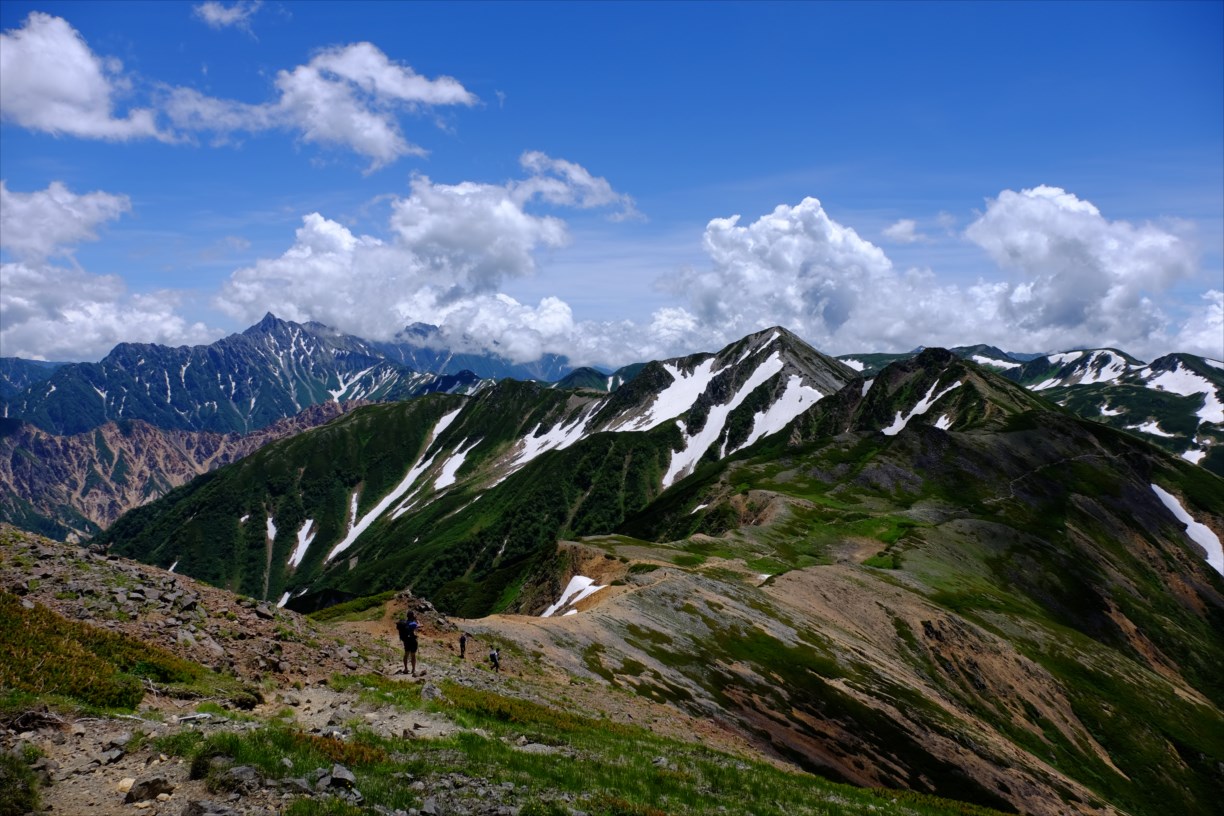
I returned to Suisho hut.
Next, I will go up to Mount washiba. The time required is 1 hour and 50 minutes.
Washiba means eagle wing in Japanese.

The snow-capped peak slightly to the left of the center of the photo is Mount Washiba.

We came to the junction between the route passing the summit of Washiba-dake and the Kurobe Genryu route.
The latter route takes less than one hour less course time.
I have been walking for a long time with heavy packs on the scorching traverse up to this point, and my stamina is at its limit.
(At the foot of the mountain on this day, the expected high temperature is 40 degrees Celsius.)
I stopped for five minutes, thinking of the impossible excuse, “It’s not that I don’t have the stamina. I want to see the Kurobe Headwaters.”
I stopped for five minutes, thinking of an impossible excuse.

I overcame the temptation to shorten my course time and arrived at the summit of Mount washiba (2,924 meters above sea level)!

From the summit of Mt. washiba, you will have a spectacular view of washiba pond.
I am glad I came to the summit.

I am going to Mitsumata hut, where we will camp on the second day.
By the way, I heard that there is a path down to Washiba Pond, but due to the difficulty in finding the path and my limited physical strength, I will not go down there.

I arrived at Mitsumata hut!
I will be here to register to set up my tent.
I can fetch drinking water for free.
Alcohol is also available for purchase.
I will be there.
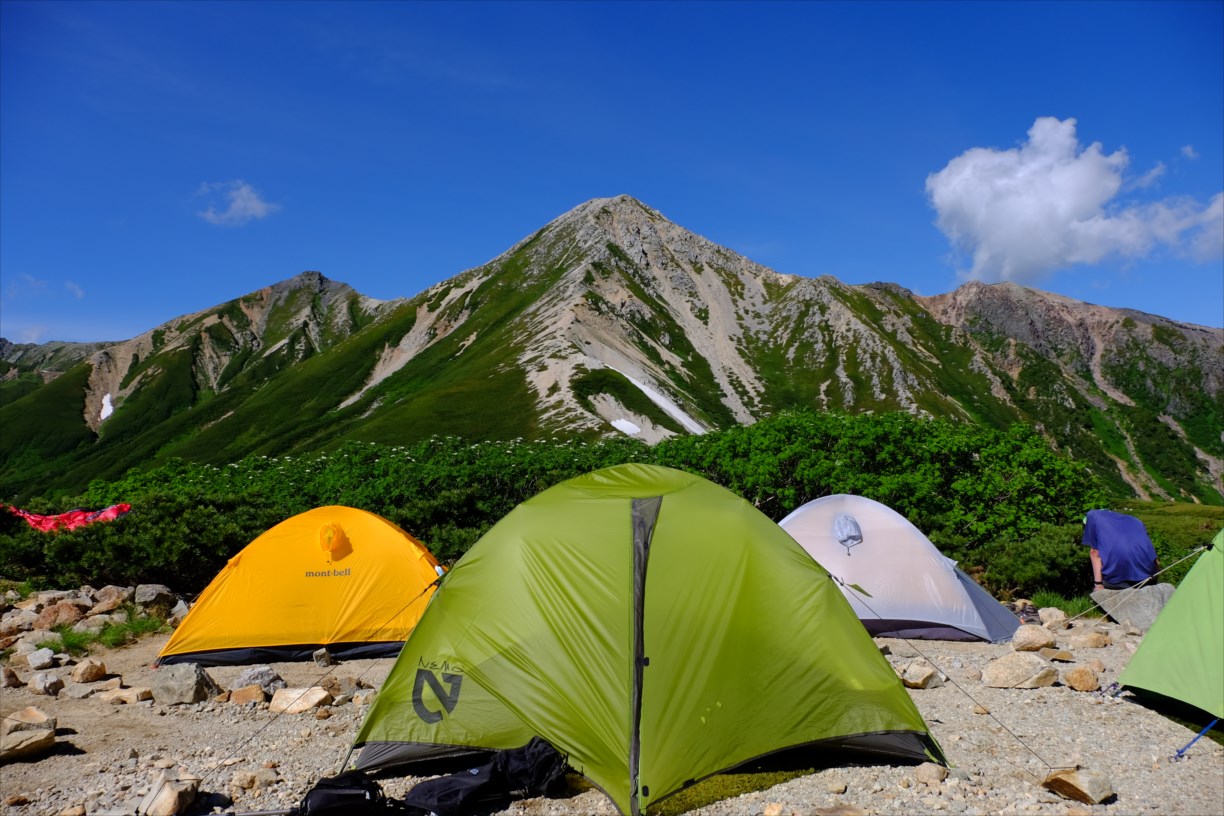
I finished putting up my tent.

Beside the tenting area, there was an abundance of snow drifts even though it was July.
The Japanese Northern Alps are a region of heavy snowfall.
The next page shows the sunset and night view.


